
The UK Company Database, Explained: What's Public, What's Not, and How to Use It
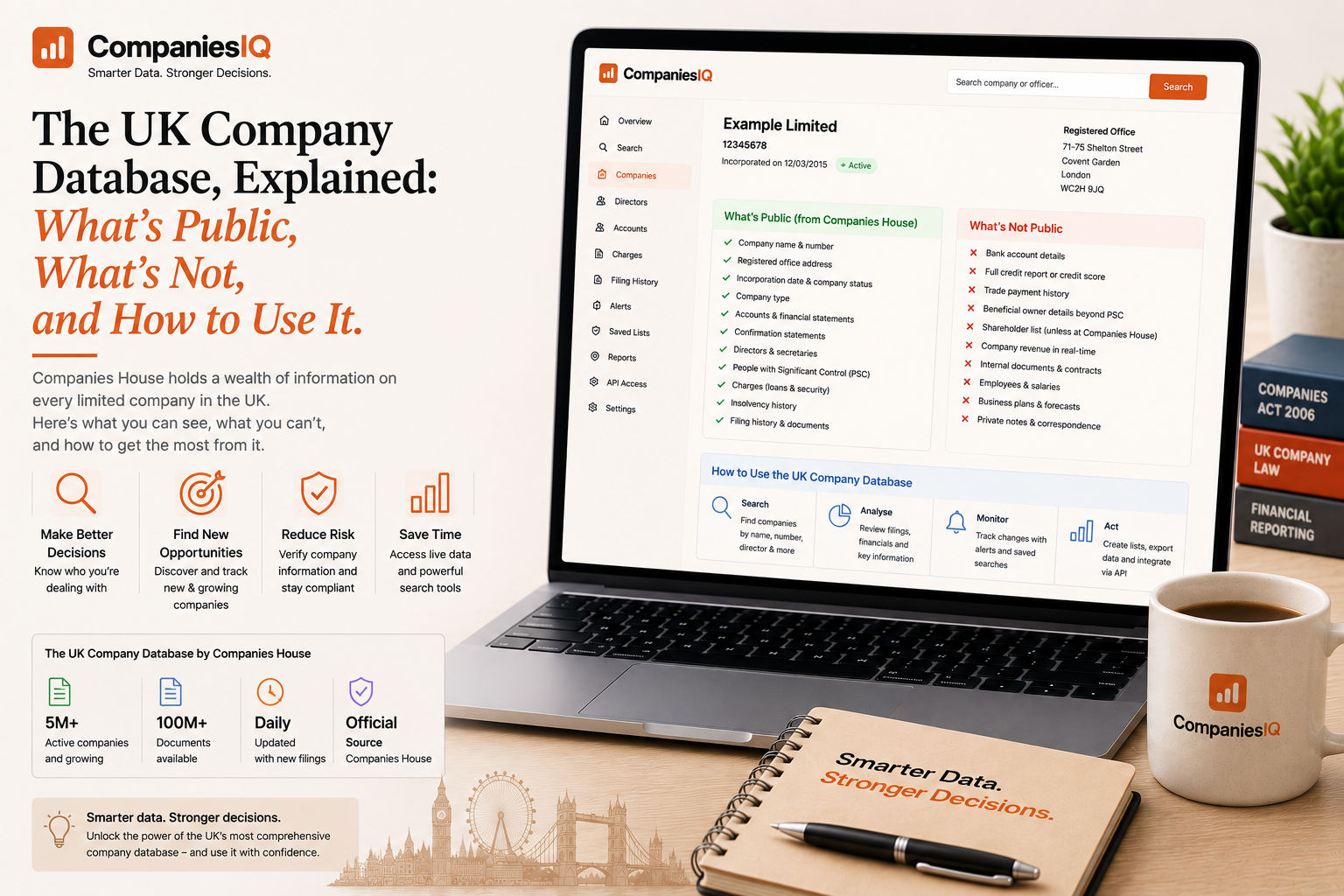
A UK company database is a structured, searchable record of the country's companies, built on the public register held by Companies House and usually enriched with extra data. At its core it tells you, for any company, who runs it, who owns it, where it is, what it does and what it has filed. The differences between databases come down to how much they add on top — financials, contact data, ownership mapping, signals — and how easily you can search and export.
The free foundation: Companies House
Everything starts with Companies House, the official registrar. It holds well over five million companies and publishes, free of charge:
- Company name, number, status and incorporation date
- Registered office address and SIC (industry) codes
- Directors and people with significant control (PSCs)
- Full filing history — accounts, confirmation statements, charges and mortgages
This is authoritative data, straight from the source. Its limits are practical: the free interface searches one company at a time, offers little bulk filtering, and is not built for list-building or analysis.
What providers add on top
Commercial databases layer extra value onto that foundation. Common additions include:
- Structured financials — turning filed accounts into comparable figures like turnover, net worth and cash, so you can screen by size or health.
- Credit and risk scores — for checking whether to extend terms to a customer or supplier.
- Contact data — phone numbers and emails appended from other sources (accuracy varies and is the most over-promised feature in the market).
- Ownership and group mapping — connecting parent companies, subsidiaries and shared directors.
- Signals and recency — new incorporations, director changes and filing events surfaced as they happen.
CompaniesIQ sits in this layer, but with a deliberate stance: it is live-only, drawing company data straight from the Companies House API and regional economic indicators from the free Nomis/ONS service, rather than reselling a stale snapshot.
Match the database to the job
Different jobs need different databases:
- Research and market sizing — you want clean industry and regional breakdowns. Pages like technology, financial services or the West Midlands turn the register into a market picture.
- Lead generation — you want recency and tight filtering. See new business leads from Companies House.
- Due diligence and KYC — you want ownership, PSCs and filing history. See who owns a company in the UK.
- Credit decisions — you want financials and scores, ideally with the filed accounts behind them.
Questions to ask before you choose
- Is it live or a snapshot? Stale data quietly costs you — dissolved companies, resigned directors, old addresses.
- Where does each figure come from? A trustworthy provider tells you what is from Companies House, what is modelled and what is third-party. CompaniesIQ publishes this on its sources page.
- Can you filter and export the way you work? By SIC code, region, recency, size.
- What does it cost at your volume? Per-search pricing and unlimited plans suit very different users — compare on pricing.
How much does a UK company database cost?
The range is wide, and it maps to how much is layered on top of the free register:
- Free — the Companies House register and its API cost nothing. You pay in engineering time and the lack of filtering, export and financials.
- Pay-as-you-go — some tools charge per report or per credit, which suits occasional checks but gets expensive for list-building.
- Subscription — a flat monthly fee for unlimited search, filtering and export, usually the best value for anyone building lists regularly rather than checking one company. See pricing for how CompaniesIQ is packaged.
The right question isn't "what's cheapest" but "what's cheapest for my job" — a per-report tool is cheap for due diligence and ruinous for prospecting, and vice versa.
Who uses a UK company database, and for what
The same underlying register powers very different jobs:
- Sales and lead generation — finding and qualifying prospects; see the UK business leads playbook and new business leads from Companies House.
- Accountants and advisers — reaching newly incorporated companies before they pick a firm.
- Due diligence, KYC and credit — verifying who owns a company and reading its filing history.
- Market research — sizing sectors and regions from formation trends.
- Monitoring — tracking a portfolio for change; see company monitoring and alerts.
The bottom line
The "best" UK company database depends entirely on the job. For authoritative core facts, nothing beats Companies House itself. For anything involving lists, filtering, recency or analysis, you want an intelligence layer on top — ideally one that stays close to the live source and is honest about where every number comes from. If you are weighing options, our piece on Companies House search alternatives compares the main routes.
Frequently asked questions
Is there a free UK company database?
Yes — the Companies House register is free and authoritative, covering over five million companies. It is excellent for single lookups but limited for bulk filtering, export and analysis, which is where commercial databases add value.
What is the difference between Companies House and a commercial company database?
Companies House is the official source of core company facts. Commercial databases build on it, adding structured financials, credit scores, contact data, ownership mapping and easier search, filtering and export.
How many companies are on the UK register?
Companies House holds well over five million companies on the register, with hundreds of thousands incorporated each year and many dissolved, so the live total moves constantly.
Is company data live or a snapshot?
It depends on the provider. Some resell periodic snapshots that go stale; others, including CompaniesIQ, query Companies House live so directors, addresses and statuses reflect the current record.
How much does a UK company database cost?
It ranges from free (the Companies House register and API) to pay-as-you-go per-report pricing to flat monthly subscriptions. Subscriptions usually offer the best value for regular list-building; per-report pricing suits occasional one-off checks.
Which is the best UK company database?
It depends on the job. Companies House is best for authoritative single lookups; a commercial intelligence layer is better for filtering, recency, financials or monitoring. Many serious users combine Companies House with one alternative.
More insights
Companies House Search Alternatives: When the Free Register Isn't Enough
The free Companies House register is authoritative but built for single lookups. Here are the alternatives — free and paid — and when each one is the right tool.
How to Find New Business Leads from Companies House (Free and at Scale)
Companies House is the richest free source of UK business leads — if you know how to turn the register into a filtered, timely prospect list. Here is the method.
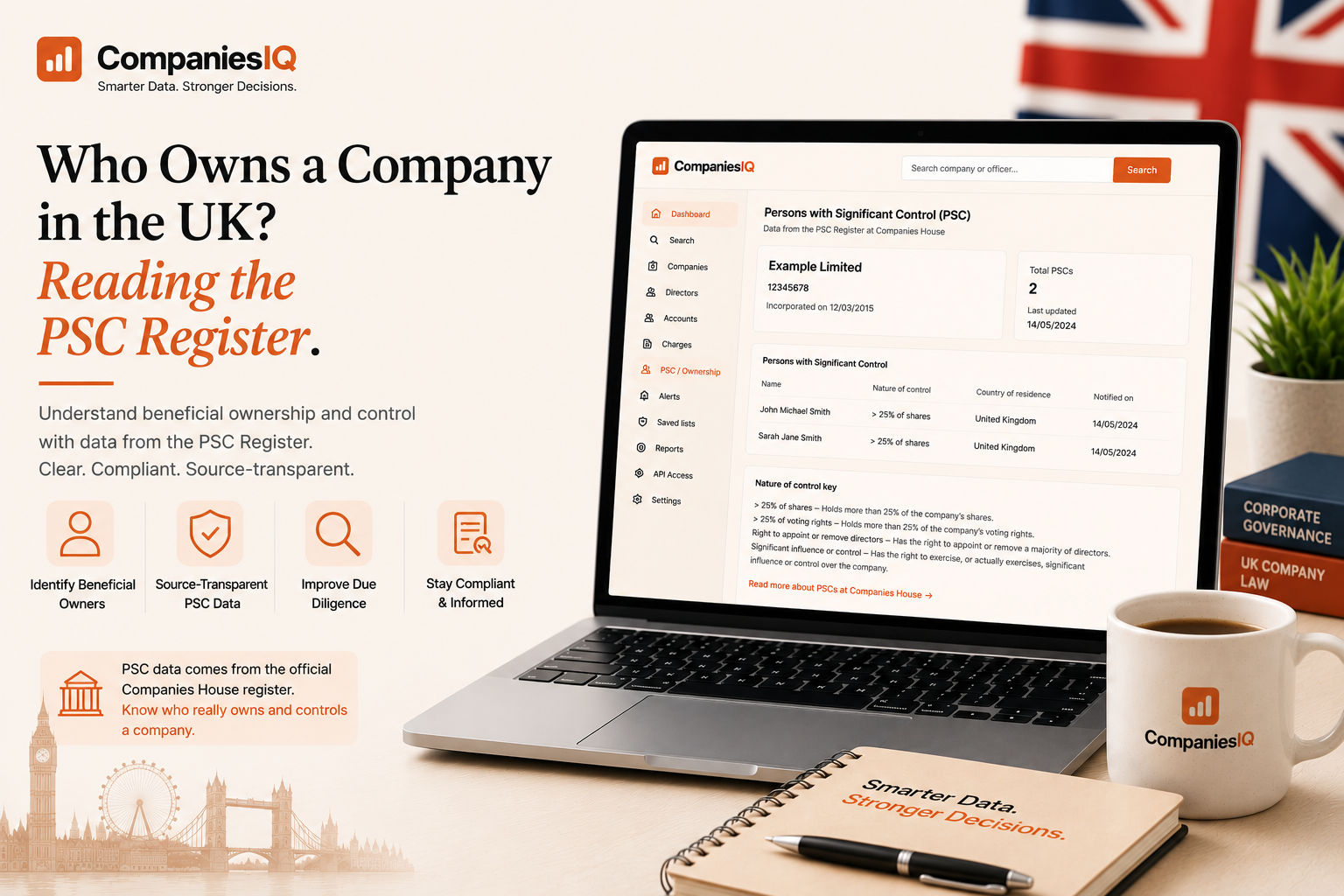
Who Owns a Company in the UK? Reading the PSC Register
How to find out who really owns and controls a UK company using the People with Significant Control register — what it shows, its thresholds, and its limits.
Go from reading to research
Create a free account to read a full company intelligence report, or upgrade for unlimited access.