
Newly Incorporated Companies UK: A Guide for Accountants and Advisers
Newly incorporated companies are limited companies that have just been registered at Companies House — a defined, publicly visible pool of businesses that did not exist the week before. For accountants, bookkeepers, tax advisers and other professional-services firms, this is one of the clearest sources of qualified opportunity in the country, because a brand-new director is about to make first decisions about accounting software, VAT, payroll and their first statutory filings, often without an adviser yet in place.
Why this pool is so valuable
Most prospecting fights for the attention of businesses that already have suppliers. New incorporations are different: the relationships are genuinely unclaimed. Within weeks of forming, a director faces:
- Choosing accounting software and a bookkeeping approach
- Deciding whether and when to register for VAT
- Setting up PAYE if they will employ people
- Understanding Corporation Tax and confirmation-statement obligations
- Their first year-end and the deadlines that follow
An adviser who arrives during that window is offering help exactly when it is needed, not interrupting a settled arrangement.
What the register tells you
When a company incorporates, the public register publishes, within days and free:
- Company name, number and incorporation date
- SIC codes describing the intended activity
- Registered office address
- Director names and people with significant control
That is enough to qualify and personalise an approach. Note that the registered office is sometimes a formation agent's address rather than the trading location, which is worth checking.
Timing the approach
The evidence points to a window of roughly one to four weeks after incorporation. Too early and the founder is still in the rush of setting up; too late and they have likely chosen an accountant. Aim for the point where the admin reality is starting to bite but no decision has been locked in.
Build a targeted list
Cast narrowly, not widely:
- By location, to match where you practise — new companies in Leeds, Birmingham, or across the South West.
- By sector, if you specialise — for example construction, hospitality or professional services. Sector specialism is a genuine differentiator in accountancy.
- By recency, to stay inside the outreach window.
You can build exactly this list on the CompaniesIQ search, then export it to work through.
Reach out compliantly
Professional-services outreach must respect PECR and UK GDPR. In practice:
- Address the director by name and reference their actual company and sector.
- Lead with genuine help — a first-year checklist, key deadlines — rather than a hard pitch.
- Identify your firm clearly and make opting out easy.
- Keep your targeting rationale on record.
Done well, new-incorporation outreach is one of the highest-converting channels available to an accountancy firm, precisely because the timing and relevance are built in. For the broader lead-generation context, see accounting leads from new companies and the general UK business leads playbook.
Frequently asked questions
How can accountants find newly incorporated companies?
Use the Companies House register, filtered for recent incorporations in your area or specialism. Platforms that ingest new formations let you filter by region, sector and recency and export the list.
When should an accountant contact a newly formed company?
Roughly one to four weeks after incorporation. By then the founder is dealing with the admin reality — software, VAT, deadlines — but has often not yet appointed an accountant.
What information about a new company is public?
Name, number, incorporation date, SIC codes, registered office and the directors and people with significant control — all free on the register within days of formation. Contact data is not included.
Is it compliant to contact new company directors?
Yes, if you follow PECR and UK GDPR: keep outreach relevant, identify your firm, and offer a clear opt-out. Sole traders and some partnerships have stronger protections than registered companies.
More insights
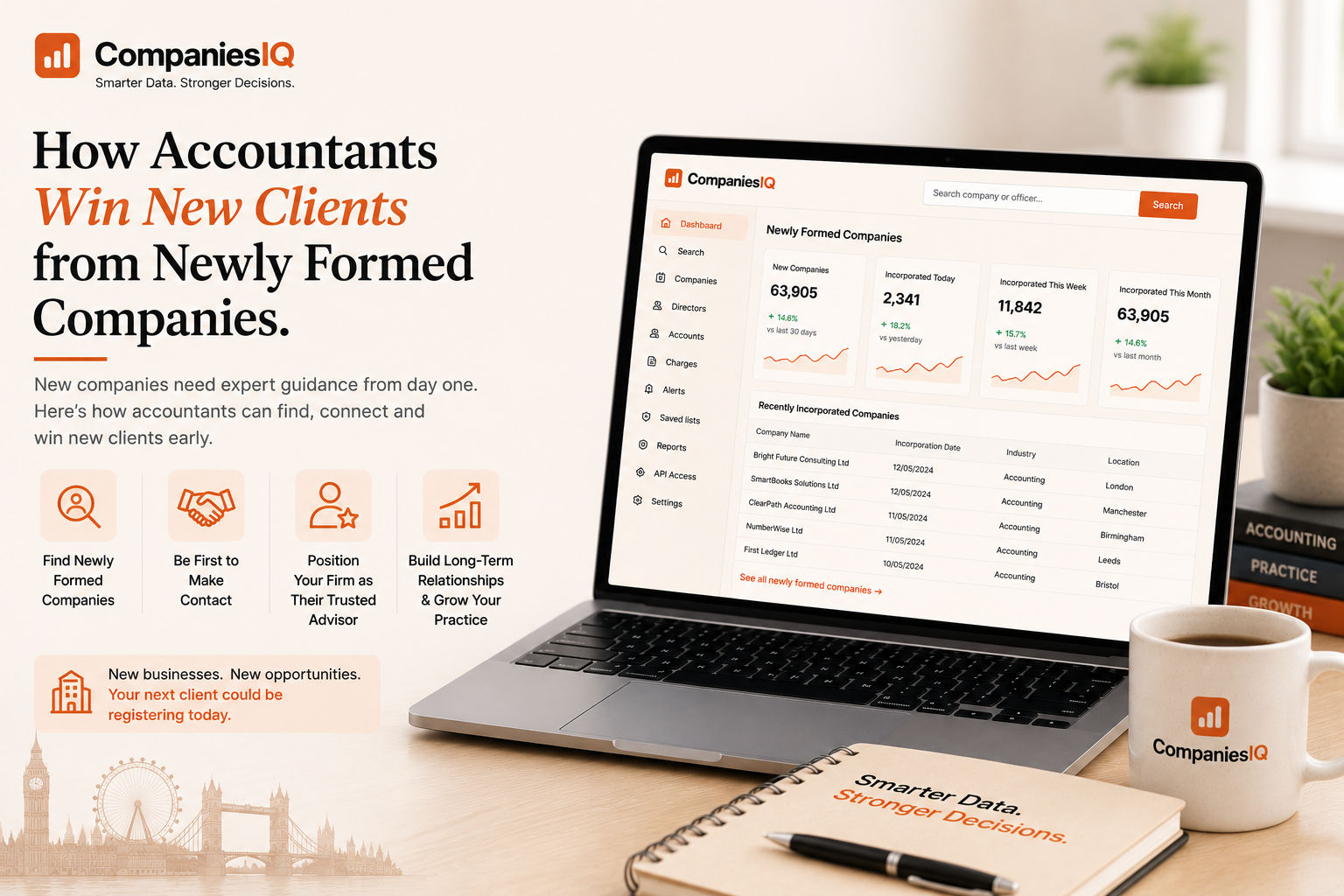
How Accountants Win New Clients from Newly Formed Companies
A focused playbook for accountancy and bookkeeping firms: turning the daily flow of new incorporations into a steady pipeline of qualified, well-timed clients.
Newly Registered Companies UK: How to Find Them (and Why Timing Wins)
A practical guide to finding newly registered UK companies on the public register, the data each one carries, and why the first few weeks after incorporation matter most.
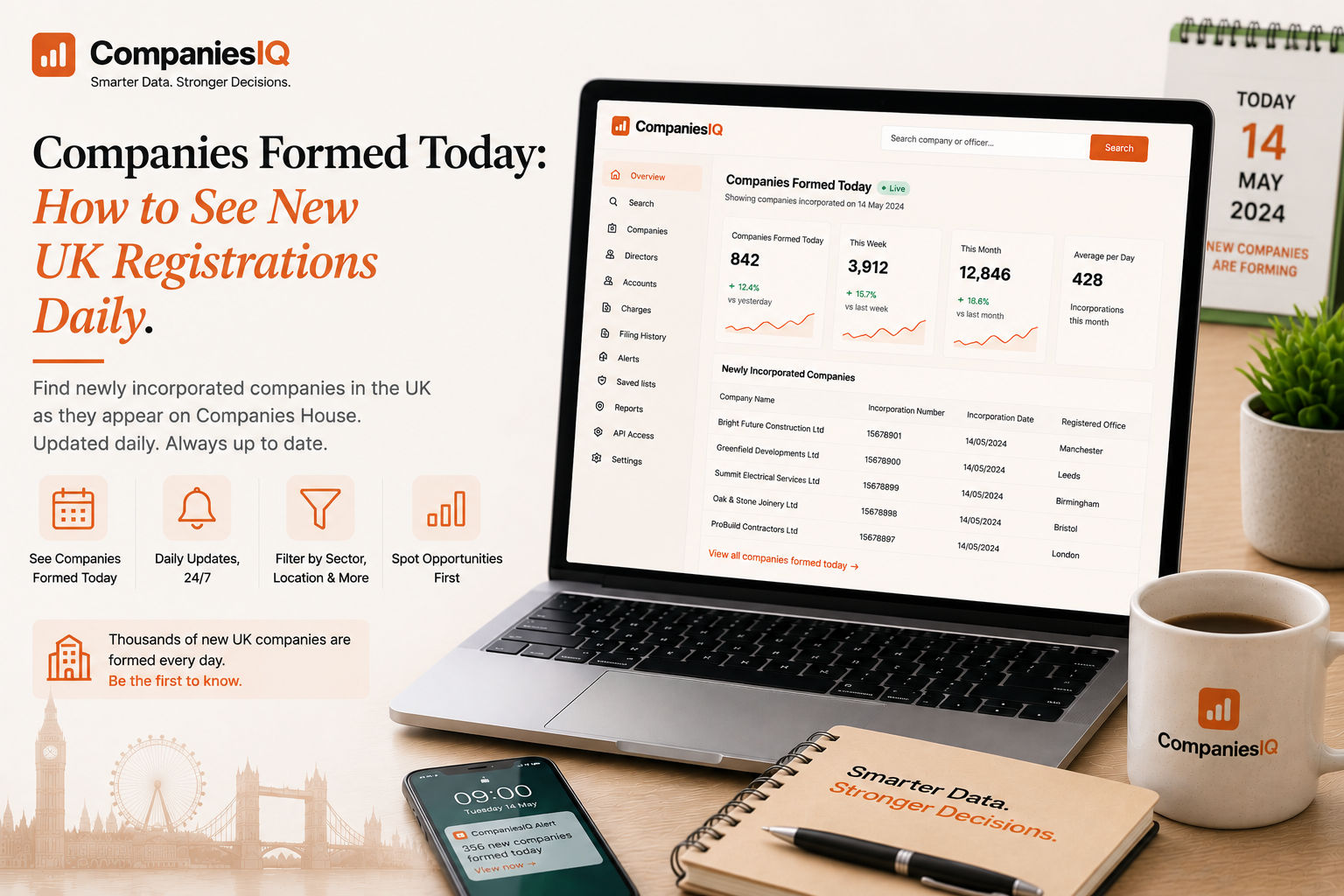
Companies Formed Today: How to See New UK Registrations Daily
How to see UK companies formed today or this week, why a daily view of new registrations is so valuable, and the practical ways to build or access one.
Go from reading to research
Create a free account to read a full company intelligence report, or upgrade for unlimited access.