
How to Find New Business Leads from Companies House (Free and at Scale)
The most reliable source of new UK business leads is the Companies House register itself. Every limited company that forms publishes its name, number, incorporation date, registered office, industry (SIC) codes and directors — a public record of businesses making fresh decisions. The skill is not finding the data; it is filtering millions of records down to the few hundred that match your customer and reaching them while the opportunity is still open.
Why the register beats a bought list
Generic B2B lists go stale the moment they are sold and are worked by everyone who buys them. The register, by contrast, refreshes every day with companies that did not exist before. A new incorporation is a defined, time-stamped event: a director has just set up a company and will soon need an accountant, a bank, insurance, software and suppliers. That is intent you can act on, not a guess.
What you can pull for free
The public register is free and includes, for every company:
- Company name, number and status (active, dissolved, in liquidation)
- Date of incorporation
- Registered office address
- SIC codes describing the business activity
- Directors and people with significant control
- Full filing history — accounts, confirmation statements and charges
That is enough to qualify a lead before you ever make contact. The limitation is the interface: the free Companies House search is built for looking up one company at a time, with no "show me everything formed last week in construction" filter and no export.
Three ways to scale it
- Companies House API. Free, well-documented, and the foundation almost every commercial tool is built on. Good if you have developers and time to maintain it. The search endpoints, however, are not designed to return new-formation feeds, so you will write logic to assemble and dedupe results.
- Commercial data lists. Several providers sell weekly or monthly files of new companies, sometimes appended with phone or email. Fast, but you are buying the same list as your competitors and the contact append varies in quality.
- An intelligence platform. A tool that continuously ingests the register and lets you filter by sector, region and recency, then export. This is what CompaniesIQ is built to do, and it keeps the underlying data attributable to its source.
Build a tight, relevant list
The mistake most teams make is going too broad. A list of "all new companies" is unworkable. Narrow on two or three axes:
- Industry, via SIC codes — for example technology, construction, professional services or real estate.
- Region or city — companies forming in London, across Scotland, or specifically in Leeds or Bristol.
- Theme, where a keyword matters more than a clean SIC code — for instance fintech, AI or recruitment.
Two filters usually take you from tens of thousands of rows to a few hundred you can genuinely work.
Qualify before you contact
Because the register includes filing history and ownership, you can score a lead before reaching out:
- Is it genuinely new, or a long-dormant shell that just filed?
- Does the registered office look like a real trading address or a formation agent's?
- Who are the directors, and what else do they run? Serial founders behave differently from first-timers.
Contact compliantly
The register tells you who and when; it does not grant marketing consent. For B2B outreach in the UK, follow PECR and UK GDPR: keep messages relevant to the recipient's business, identify yourself, and make opting out easy. Used this way — register for targeting, legitimate channels for contact — new-company data is both effective and defensible. See pricing for how CompaniesIQ packages this, and sources for the provenance of every figure.
Frequently asked questions
Is it legal to use Companies House data for sales leads?
Yes. The register is public and free to use, including for business development. Contacting companies is separate: B2B outreach must follow PECR and UK GDPR, so keep it relevant, identify yourself and honour opt-outs.
Does Companies House give you contact phone numbers or emails?
No. The register provides company and officer details and a registered office address, but not marketing contact data. Phone and email appends come from third-party enrichment, with varying accuracy.
What is the cheapest way to get new business leads?
The register itself is free. The cheapest scalable route is the free Companies House API if you can build tooling; otherwise an intelligence platform saves the engineering and adds filtering and export.
How do I avoid working the same leads as everyone else?
Filter tightly by sector, region and recency, and act on new formations quickly. Niche, time-sensitive lists are far less contested than broad bought files.
More insights
Newly Registered Companies UK: How to Find Them (and Why Timing Wins)
A practical guide to finding newly registered UK companies on the public register, the data each one carries, and why the first few weeks after incorporation matter most.
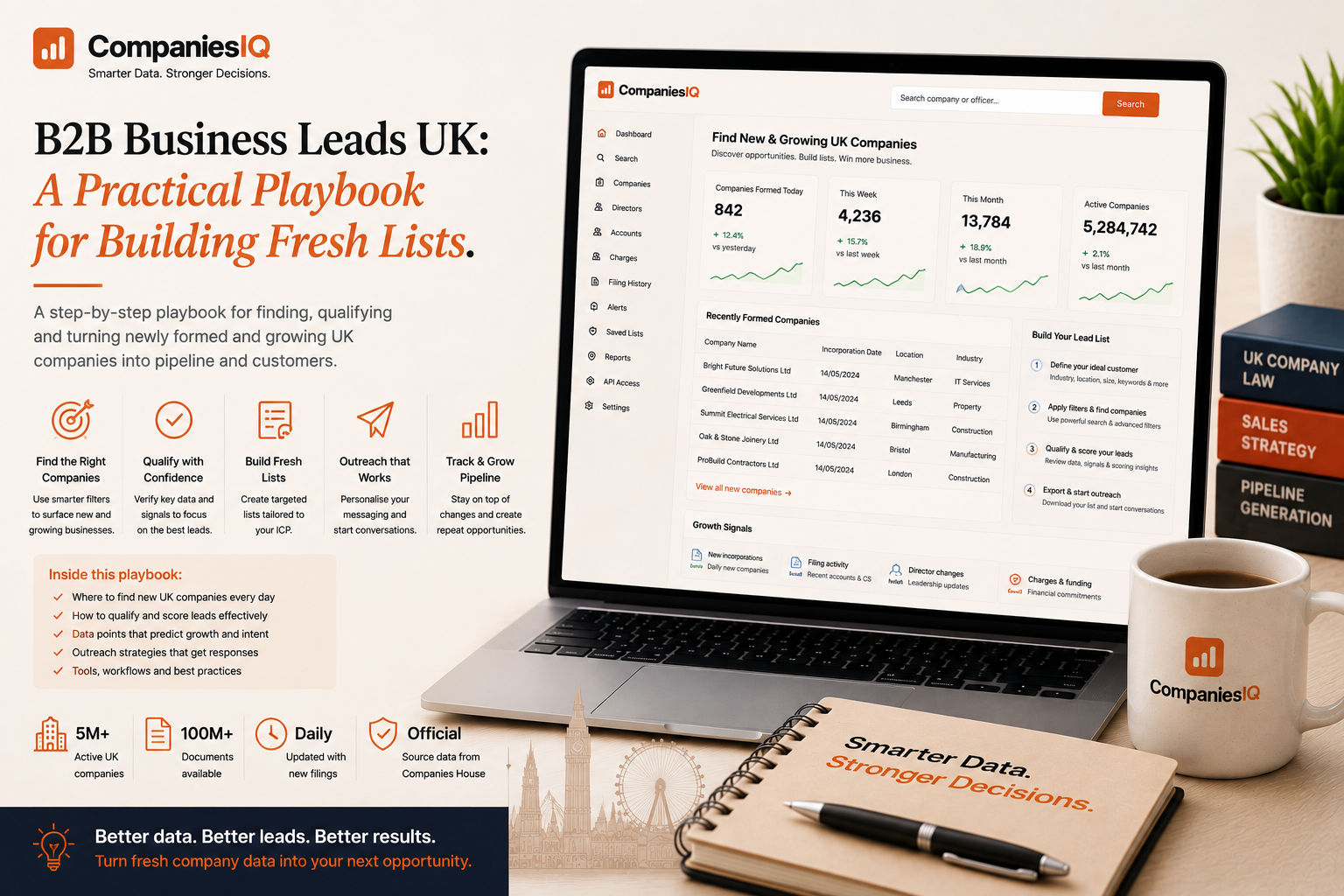
B2B Business Leads UK: A Practical Playbook for Building Fresh Lists
Where UK B2B leads actually come from, how to build a list that converts, and the difference between a bought file and a feed of companies making decisions right now.
SIC Codes Explained: How to Target Companies by Industry
What SIC codes are, how the UK uses them on the company register, their quirks and limits, and how to use them to target or analyse companies by industry.
Go from reading to research
Create a free account to read a full company intelligence report, or upgrade for unlimited access.