
Newly Registered Companies UK: How to Find Them (and Why Timing Wins)
Newly registered companies in the UK are limited companies that have just been incorporated and added to the public register held by Companies House. Every one of them becomes searchable within days of formation, complete with company name, company number, incorporation date, registered office address, SIC (industry) codes and the names of the directors. That public record is the single best signal of fresh commercial intent in the country — a business that did not exist last week and is about to make its first decisions about banking, accounting, software and suppliers.
Where the data comes from
Companies House is the official registrar of companies in England and Wales, Scotland and Northern Ireland. When someone forms a limited company, its core details are published on the register and made available free of charge. Hundreds of thousands of companies are incorporated in the UK each year, so the flow of new entities is constant rather than seasonal.
The free Companies House register is excellent for looking up a single company you already know. What it does not do well is the opposite job — handing you a filtered, exportable list of every company formed in the last seven days in a given sector or region. That is the gap most teams need to close.
What a new registration tells you
A single new incorporation carries more than a name. From the public record you can usually read:
- Company name and number — the permanent identifier you can track over time.
- Incorporation date — the clock that tells you exactly how fresh the lead is.
- Registered office address — useful for geographic targeting, though some are accountants' or formation agents' addresses rather than the real trading site.
- SIC codes — the Standard Industrial Classification codes that describe what the company says it does. These are how you target by industry. See our guide to SIC codes for how to read them.
- Directors and people with significant control — who runs and who owns the company. Under the Economic Crime and Corporate Transparency Act, directors and PSCs now have to verify their identity with Companies House, which improves the quality of this data over time.
Why timing is everything
The value of a new registration decays quickly. In the first one to four weeks after incorporation, a director is choosing an accountant, opening a business bank account, registering for VAT or PAYE if needed, and building a website. After a few months most of those decisions are made and a competitor has already won the relationship.
This is why a new-company feed beats a generic prospect list. You are not interrupting a settled business; you are arriving exactly when a decision is open. Accountants, banks, insurers, software vendors and agencies all compete in that same narrow window — the guide on accounting leads from new companies goes deeper on the professional-services angle.
How to build a usable feed
There are three broad routes:
- Manual lookups on Companies House — free, but no date or sector filtering and no export, so impractical at volume.
- The Companies House API — free and powerful, but you have to build and maintain the tooling, and the search endpoints are not designed to return "everything formed yesterday."
- An intelligence layer on top of the register — a platform that ingests new incorporations continuously and lets you filter by sector, region and recency, then export. That is the job CompaniesIQ does.
Targeting by sector and place
The fastest way to make a new-company feed productive is to narrow it. A few examples drawn from live register data:
- Agencies often watch high-formation consumer sectors such as hospitality, beauty and ecommerce.
- B2B sellers track technology, professional services and construction.
- Local firms filter by place — for example new companies in Manchester, Birmingham or across the North West.
Combining a sector signal with a region gives you a short, relevant list rather than thousands of rows you will never work through.
Newly registered vs dormant, shelf and re-registered companies
Not every "new" entry on the register is a genuine fresh business, and the difference decides lead quality:
- Genuinely newly incorporated — formed this week to start trading. This is the real opportunity.
- Shelf companies — incorporated in advance and left dormant to be sold on later, so the incorporation date predates any real activity.
- Dormant companies — registered but not trading (sometimes just to protect a name); a dormant-accounts filing is the tell.
- Re-registrations and name changes — an existing business under a new identity, not a new customer.
A good new-company feed lets you screen these out — excluding dormant filings and sense-checking that the office and directors look like a real, active setup. The signals that separate a trading business from a shell are in how to read a company's filing history.
Build your first list in ten minutes
A practical starting workflow:
- Pick one sector and one region you actually serve — say technology companies in London. Two filters beat twenty.
- Set a recency window — the last 7 to 30 days, so every company is still inside the decision window.
- Scan the directors and PSCs — first-time founder or experienced operator? Cross-reference a company director search and check who owns the company.
- Export the shortlist and work it while it's fresh — run the search on the live register.
For the day-by-day flow rather than a one-off pull, see companies formed today; for the full method, the new business leads playbook and the UK company database explainer go deeper.
Prefer it delivered? Get a free weekly email of newly registered companies in your sector and region — no account needed.
A note on contact data and compliance
The register gives you company and officer details, not marketing consent. If you plan to contact new companies, treat directors' details as business data and follow PECR and UK GDPR — keep B2B outreach relevant, identify yourself clearly and honour opt-outs. The cleanest approach is to use the register to decide who to contact and when, then reach them through legitimate channels.
You can see exactly which figures on CompaniesIQ are live from Companies House versus published reference data on our sources page.
Frequently asked questions
Are newly registered companies public in the UK?
Yes. When a limited company is incorporated, Companies House publishes its core details — name, number, incorporation date, registered office, SIC codes, directors and people with significant control — on the public register, free to access.
How quickly do new companies appear on the register?
Usually within a day or two of incorporation. Online formations are often registered within 24 working hours, so a new company can be visible the next working day.
When is the best time to contact a newly formed company?
Roughly one to four weeks after incorporation. By then the initial setup rush has settled and the director is making decisions about accounting, banking, VAT and suppliers, but has often not yet committed to providers.
Can I download a list of newly registered companies?
Not directly from the free Companies House website, which has no date filter or bulk export. You need the Companies House API or an intelligence platform that ingests new incorporations and lets you filter and export them.
What's the difference between a newly registered and a dormant company?
A newly registered company has just incorporated to trade; a dormant company is registered but not trading (its accounts are filed as dormant). For lead quality, target genuinely new, active incorporations and screen out dormant shells and shelf companies.
How many new companies are registered in the UK?
Hundreds of thousands of companies are incorporated each year on the Companies House register — a constant daily flow rather than a seasonal spike, which is why a filtered, recency-based feed beats a periodic bulk list.
More insights
How to Find New Business Leads from Companies House (Free and at Scale)
Companies House is the richest free source of UK business leads — if you know how to turn the register into a filtered, timely prospect list. Here is the method.
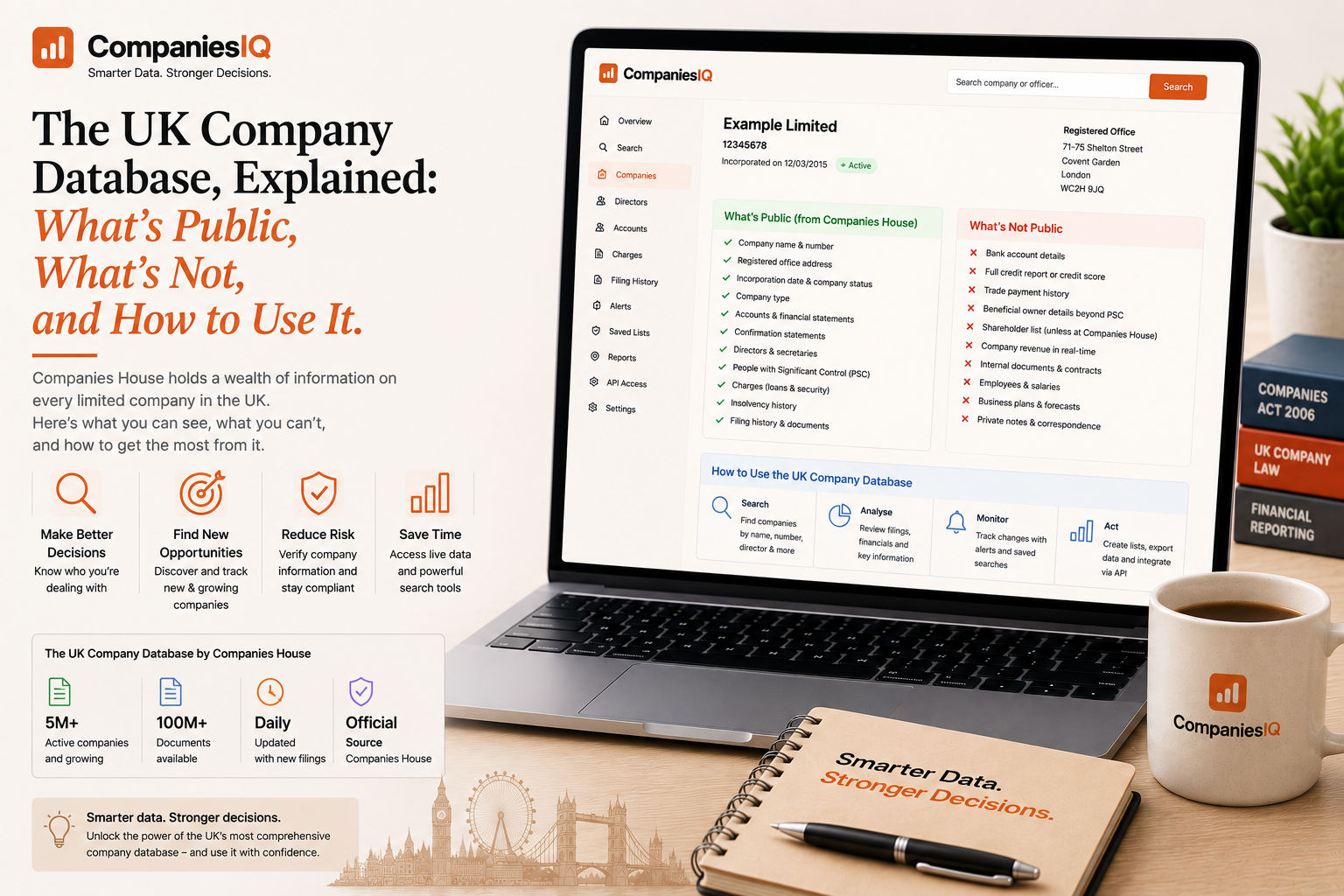
The UK Company Database, Explained: What's Public, What's Not, and How to Use It
What a UK company database actually contains, which parts come free from Companies House, what providers add on top, and how to choose the right one for your job.
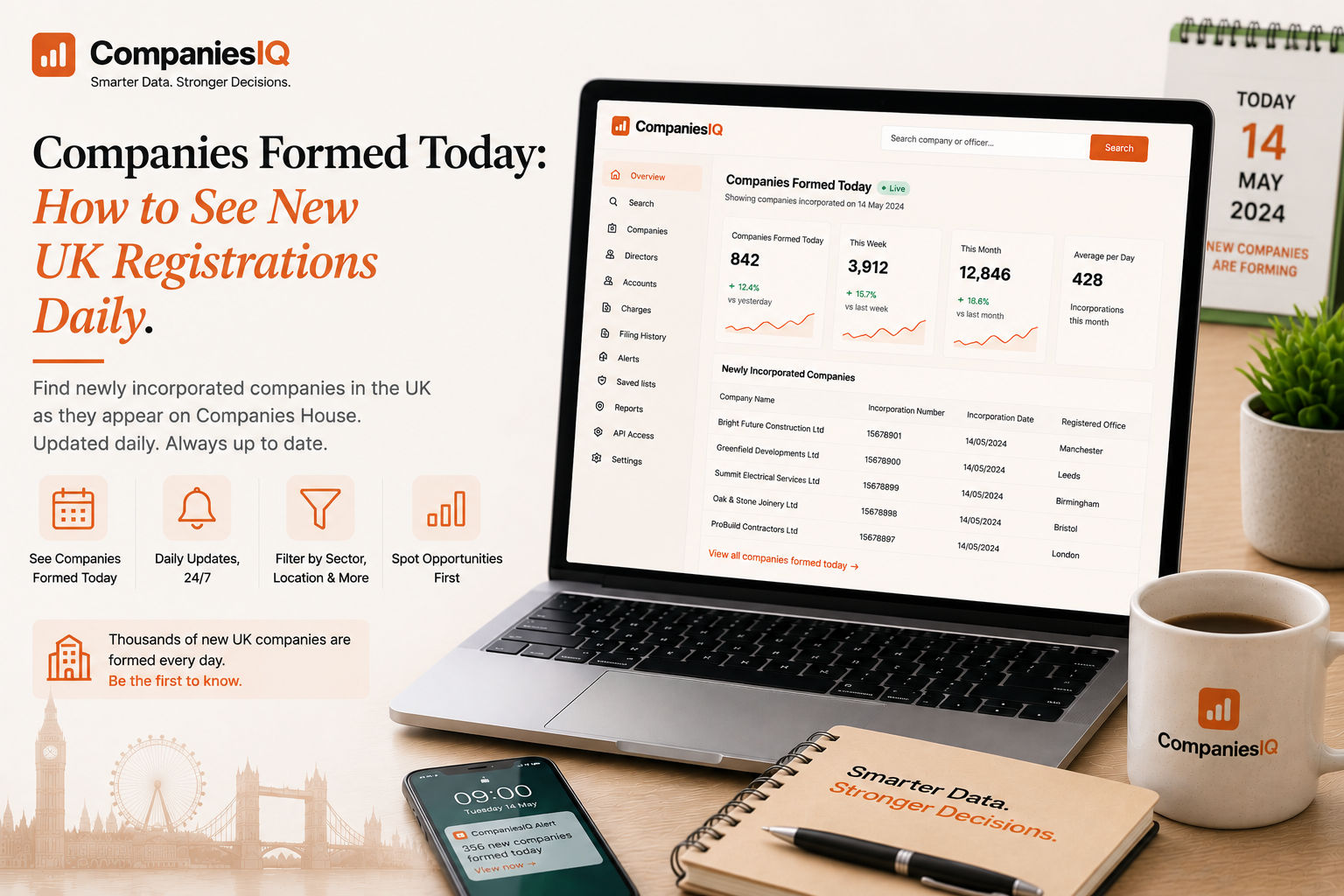
Companies Formed Today: How to See New UK Registrations Daily
How to see UK companies formed today or this week, why a daily view of new registrations is so valuable, and the practical ways to build or access one.
Go from reading to research
Create a free account to read a full company intelligence report, or upgrade for unlimited access.