
SIC Codes Explained: How to Target Companies by Industry
A SIC code — Standard Industrial Classification code — is a five-digit number that describes what a company does, recorded against every UK company on the Companies House register. SIC codes are the primary way to filter, target and analyse companies by industry: choose the right codes and you can isolate, say, every new software company or every construction firm in a region. But they have well-known quirks, and using them well means understanding both their power and their limits.
What a SIC code is
When a company is formed or files a confirmation statement, it declares one or more SIC codes from the official UK list, each describing a type of economic activity. For example, software development, residential construction and management consultancy each have their own code. A company can list several codes if it does more than one thing.
These codes are public and free on the register, and they are what underpins industry filtering in every company database, including the sector pages on CompaniesIQ.
How to use them to target
SIC codes turn the register from a pile of companies into a filterable market:
- Build an industry list. Select the codes that define your target — for example software and IT codes for technology, or building and trades codes for construction.
- Combine with region. Industry plus place gives a precise list — software companies in London, or construction firms across the North West.
- Combine with recency. New companies in a SIC band are a lead feed; the whole band is a market map.
Run these combinations on the CompaniesIQ search.
The quirks to know
SIC codes are useful but imperfect, and serious users account for it:
- Self-declared. Companies choose their own codes, and many pick something broad, generic or slightly wrong — especially at formation, before the business has settled.
- Sometimes generic. Codes like "other business support service activities" or "dormant company" carry little information.
- Multiple codes. A company with several codes may be genuinely diversified, or may just have hedged at registration.
- Not always updated. A pivoting company may keep an outdated code until its next confirmation statement.
Because of this, SIC codes are best treated as a strong first filter, not the final word.
Going beyond SIC
For activities that do not map cleanly to a code, keyword and theme filtering complements SIC. A fast-moving area like AI or fintech is often better captured by what a company says about itself than by the code it picked. CompaniesIQ's signal themes combine both approaches — the structured SIC band plus the descriptive term that best surfaces a theme.
Using SIC for analysis
Beyond targeting, SIC codes power market analysis: counting formations by industry over time, comparing sectors across regions, and spotting where activity is concentrating. Pair that with ONS sector baselines — clearly sourced on the CompaniesIQ sources page — and you can put register activity in proper economic context. Just remember the self-declared caveat when you draw conclusions: SIC tells you what companies say they do, which is close to, but not identical with, what they actually do.
Frequently asked questions
What is a SIC code?
A Standard Industrial Classification code: a five-digit number that describes a company's type of economic activity, declared by the company and recorded on the Companies House register. It is the main way to filter companies by industry.
How do I find a company's SIC code?
Look the company up on Companies House; its SIC code(s) appear on the overview, declared at formation and updated on the confirmation statement. A company can list more than one.
Are SIC codes accurate?
They are self-declared, so treat them as a strong first filter rather than the final word. Companies sometimes pick broad, generic or outdated codes, or list several, so combine SIC with keyword or theme filtering for precision.
How do I target companies by industry?
Select the SIC codes that define your target industry, then combine them with region and recency to build a precise list. For fast-moving themes not captured cleanly by SIC, add keyword or signal filtering.
More insights
How to Find New Business Leads from Companies House (Free and at Scale)
Companies House is the richest free source of UK business leads — if you know how to turn the register into a filtered, timely prospect list. Here is the method.
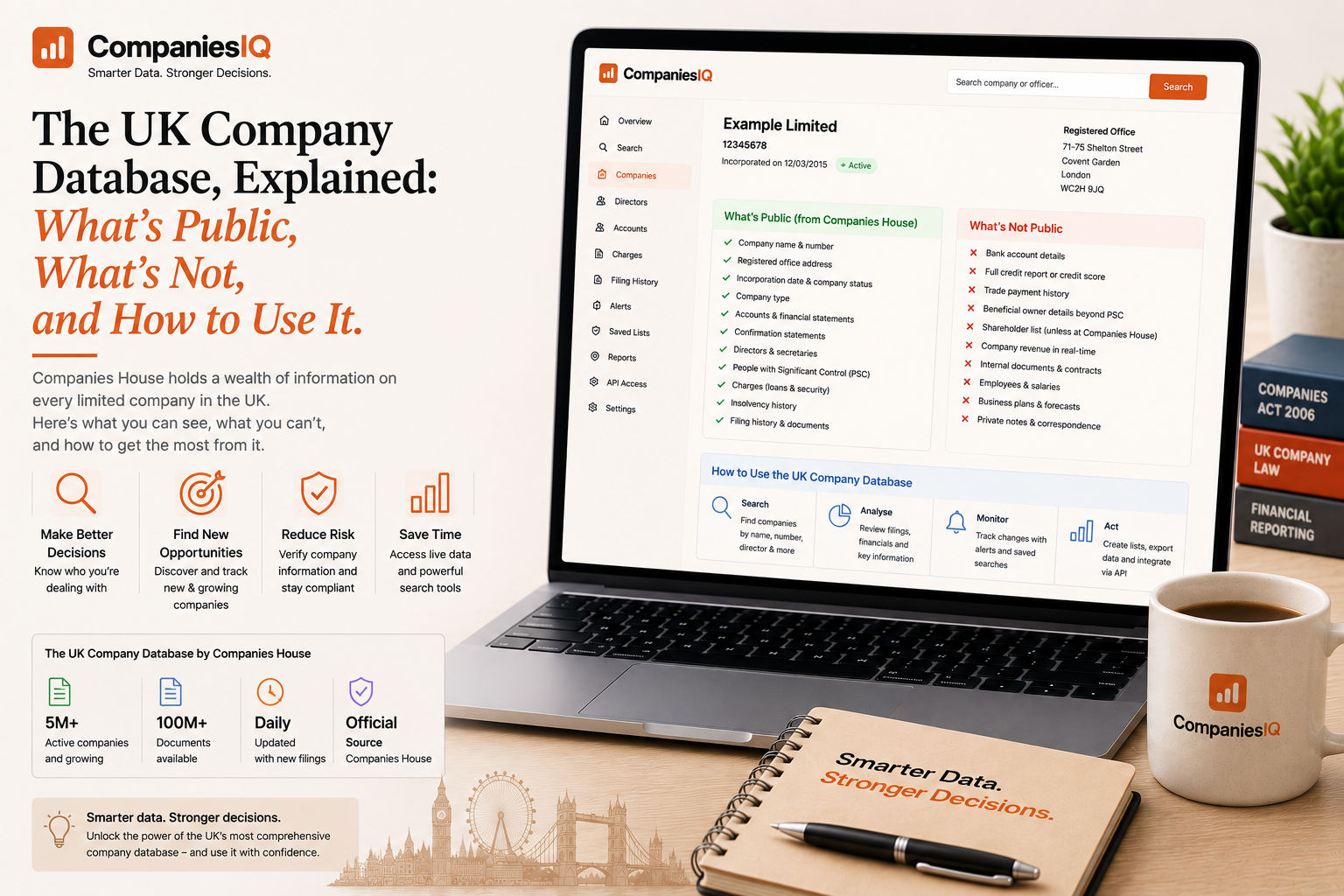
The UK Company Database, Explained: What's Public, What's Not, and How to Use It
What a UK company database actually contains, which parts come free from Companies House, what providers add on top, and how to choose the right one for your job.

How Companies House Works: The UK Register Explained
Companies House is the UK's official registrar of companies. Here's what it is, what's on the register, what companies must file, and how to actually use the data.
Go from reading to research
Create a free account to read a full company intelligence report, or upgrade for unlimited access.