
How to Research a UK Company: A Step-by-Step Guide

To research a UK company, start with the public Companies House record and work outward: confirm it exists and is active, check who runs and owns it, read its accounts and filing history, and look for signals — charges, address changes, resignations — that add context. Almost everything you need is public and free. This guide walks through each step and what it actually tells you.
Step 1 — Confirm the company and its status
Search the company by name or number and confirm the basics: it is a real, registered company, its status is active (not dissolved or in liquidation), and its incorporation date. A company that formed last week is a very different prospect — or risk — from one trading for twenty years. You can browse companies by industry, region or city to put one in context.
Step 2 — Check the people
Look at the directors and secretaries: who they are, when they were appointed, and what other companies they run. A director with a long trail of dissolved companies is worth noting. See company director search for how to follow a person across companies.
Step 3 — Check ownership and control
Directors run a company day to day, but the persons with significant control (PSCs) ultimately own or control it — typically anyone holding more than 25% of shares or voting rights. The PSC record tells you who is really behind the business, and a recent PSC change often marks a sale or investment.
Step 4 — Read the accounts
A company's annual accounts show its financial position — though how much detail you get depends on its size, as small and micro companies file less. Look at net worth, whether accounts are filed on time, and the trend across years. Late or overdue accounts are a genuine red flag.
Step 5 — Read the filing history
The filing history is a dated timeline of everything the company has told Companies House. Scan it for pattern and pace: frequent officer changes, a new charge (secured borrowing), or a registered-office move can all be meaningful in context.
Step 6 — Watch for change
Research is a snapshot; companies change. If the company matters to you — a prospect, a supplier, a competitor — track it and get alerted when it files, changes directors or moves. That's what company monitoring is for.
Doing this at scale
Researching one company is a manual job. Researching many — every new company in your market, say — needs a tool that searches the live register in bulk and assembles each company's people, ownership and filings into one report. That's the difference between the free register and a company database built for research and prospecting. Different jobs use it differently — see the use-case guides for accountants, recruiters, agencies and sales teams.
Ready to try it on a real company? Search the live register, or read how Companies House works for the foundations.
Frequently asked questions
How do I research a UK company for free?
Use the public Companies House register: confirm the company and its status, check its directors and persons with significant control, read its accounts and filing history, and note any charges or recent changes. All of this is public and free.
What are the red flags when researching a company?
Overdue or late accounts, a director with many dissolved companies, frequent registered-office or officer changes, a very recent incorporation presented as an established firm, and a status of dissolved or in liquidation. Each is context, not proof — weigh them together.
How do I find out who owns a UK company?
Check the persons with significant control (PSC) record on the register — usually anyone holding more than 25% of shares or voting rights, or with rights to control the company. Directors run it; PSCs ultimately own or control it.
Can I research many companies at once?
Not through the free register, which is built for single lookups. A company-intelligence platform that queries the register live lets you search in bulk by sector, region and recency, and assemble each company's data into one report.
More insights

How Companies House Works: The UK Register Explained
Companies House is the UK's official registrar of companies. Here's what it is, what's on the register, what companies must file, and how to actually use the data.
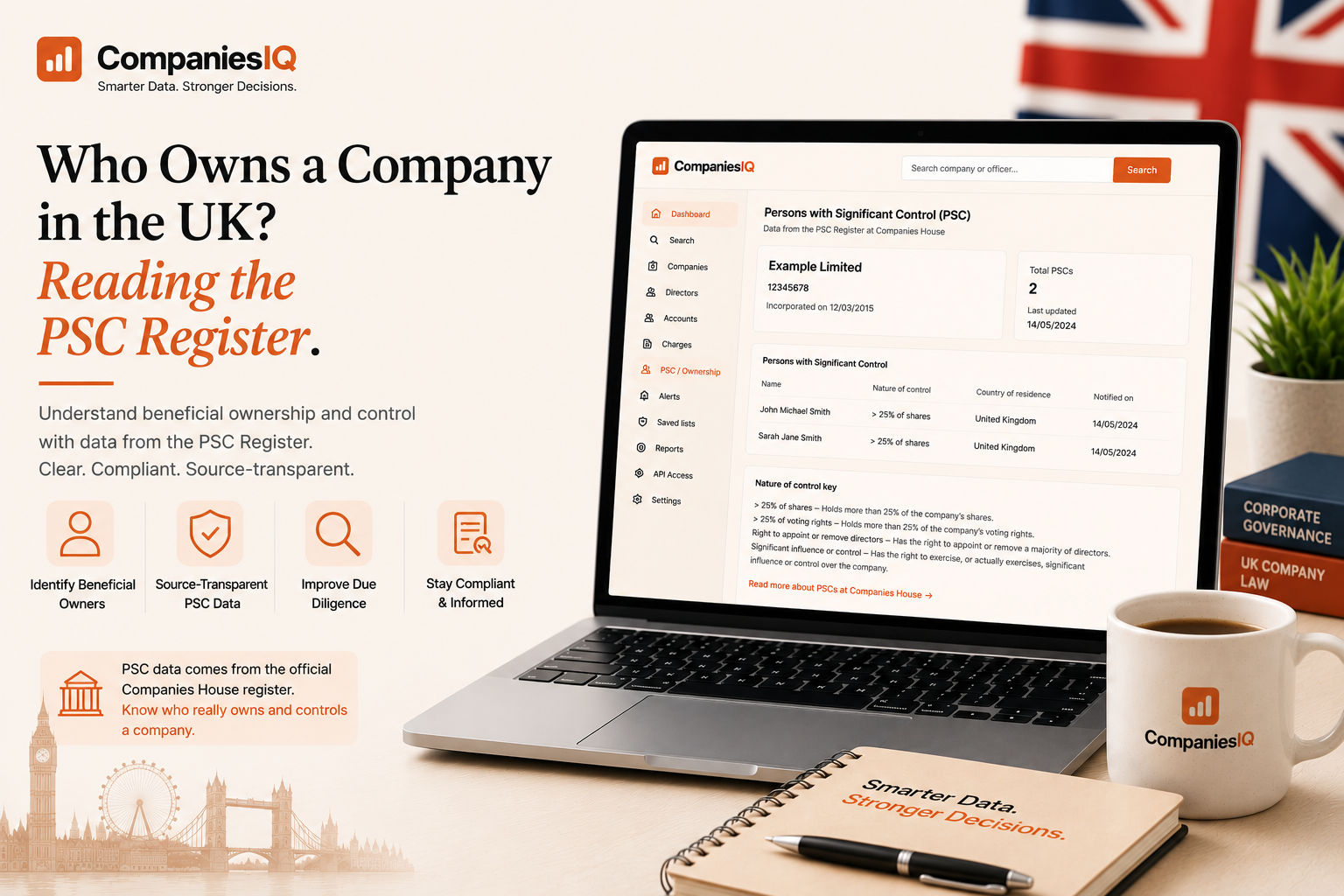
Who Owns a Company in the UK? Reading the PSC Register
How to find out who really owns and controls a UK company using the People with Significant Control register — what it shows, its thresholds, and its limits.
.png)
How to Read a Company's Filing History (Accounts, Confirmation Statements & More)
A plain-English guide to reading a UK company's filing history on Companies House — what accounts, confirmation statements, charges and other filings actually tell you.
Go from reading to research
Create a free account to read a full company intelligence report, or upgrade for unlimited access.