
Finding High-Growth and Funded Companies in the UK
High-growth and funded companies are the most sought-after targets for investors, sales teams, recruiters and partners — and while the Companies House register does not label a company "high-growth", it carries the signals that point to one. Ownership changes, secured borrowing, experienced new directors and patterns of formation all hint at momentum and investment. This guide explains which signals you can read for free, which need enrichment, and how to combine them.
What "high-growth" means in the data
There is no official high-growth flag on the register. In practice, you infer it from a cluster of signals that, together, suggest a company is scaling and attracting capital. No single signal is conclusive; the pattern is what matters.
Signals you can read for free
Ownership changes (PSCs)
When a new individual or entity crosses the 25% threshold and appears as a person with significant control, it often marks an equity investment or a significant restructuring. A change in the PSC register is one of the clearest free signals of a funding event — see who owns a company in the UK.
Charges and mortgages
A new charge means the company has raised secured finance — venture debt, a bank facility, asset finance. The presence and timing of charges is a strong indicator of capital being deployed for growth. Learn to read them in how to read filing history.
Experienced new directors
When a young company appoints directors with strong track records — people who have run or scaled other companies — it often signals ambition and outside backing. You can trace those track records via the company director search.
Formation patterns
Clusters of related new companies, or a founder spinning up a new venture, can mark the start of a high-growth story. New formations in hot sectors are covered in startup database UK.
Where to look
High-growth activity concentrates by sector and place:
- Sectors and themes — AI, fintech, SaaS and cleantech dominate venture-backed formation; the broader technology and financial services pages give the market context.
- Places — London leads, with strong clusters in Manchester, Edinburgh, Cambridge and Bristol.
Run combined sector-and-region searches on the CompaniesIQ search.
What the register won't tell you
Be realistic about the limits. The register does not show:
- Funding round sizes or valuations
- Named investors beyond those who become PSCs
- Revenue, growth rates or headcount
Specialist providers model and collect some of this — for example platforms focused specifically on high-growth and venture-backed companies. CompaniesIQ deliberately stays close to the live official record and is clear on its sources page about what is live versus reference data, rather than presenting modelled figures as fact.
Putting it together
The reliable method is to combine signals: a young company, in a high-growth sector, that has just had a PSC change and registered a charge, and brought in an experienced director, is far more likely to be genuinely scaling than one showing any single signal alone. Read the pattern, confirm it in the filing history, and you have a high-quality shortlist — built entirely from public data.
Frequently asked questions
How can I find high-growth companies in the UK?
Read the register for clustered growth signals — PSC (ownership) changes, new charges, experienced new directors and formation patterns — in high-growth sectors and regions. The pattern, not any single signal, indicates real growth.
Can I see if a company has raised funding on Companies House?
Partly. New investors crossing 25% appear as people with significant control, and secured finance shows as charges. Round sizes, valuations and most investor names are not on the register and require specialist data.
Which sectors have the most high-growth UK companies?
Venture-backed growth concentrates in AI, fintech, SaaS and cleantech, within the broader technology and financial-services sectors, and clusters geographically around London, Manchester, Edinburgh, Cambridge and Bristol.
What growth signals are strongest?
A PSC change (often investment) and a new charge (secured finance) are the clearest free signals, especially together with an experienced new director at a young company in a high-growth sector.
More insights
Startup Database UK: How to Track Newly Formed Companies
How to build a live view of UK startups from the public register — what counts as a startup, what data you can get, and how to track them by sector and stage.
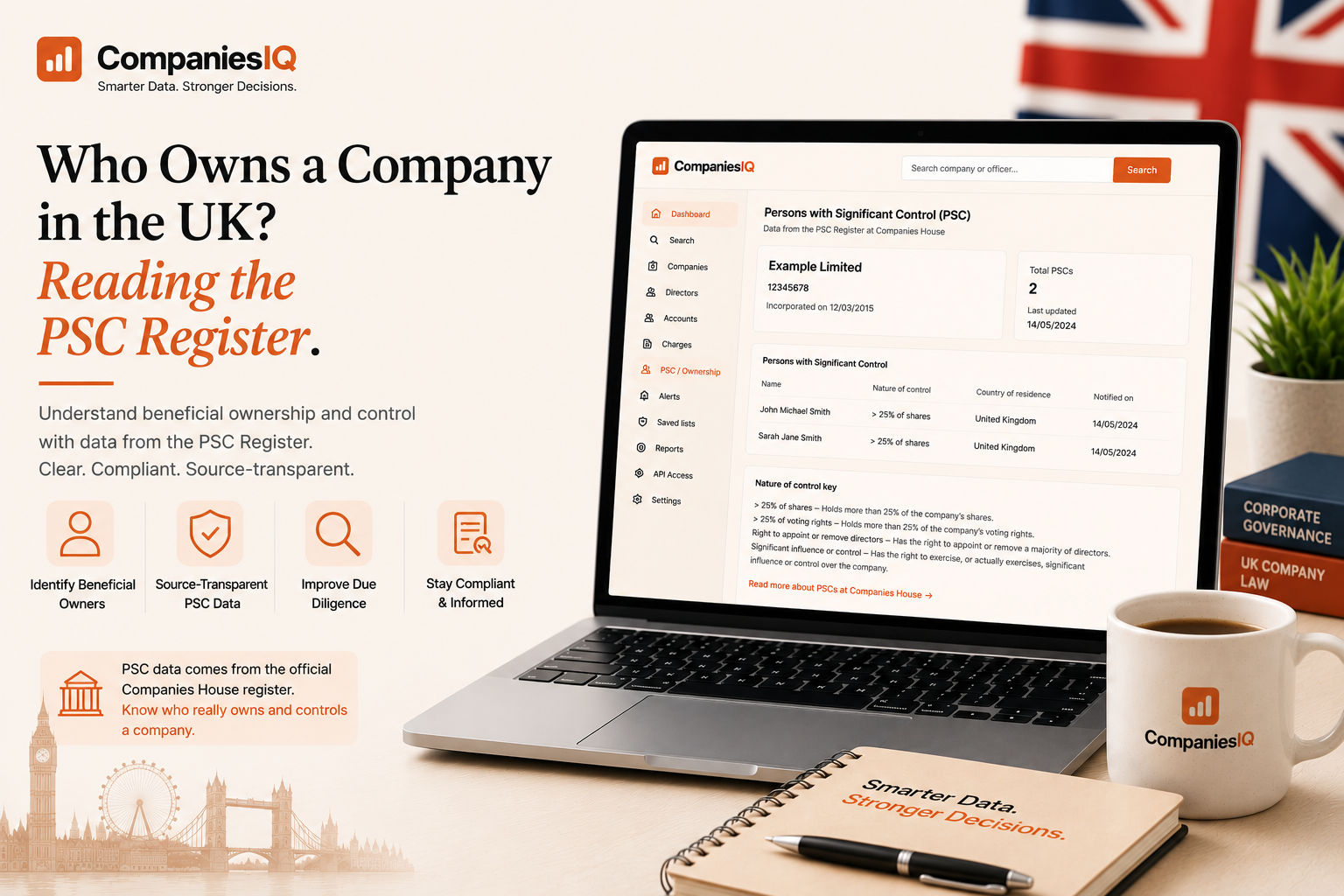
Who Owns a Company in the UK? Reading the PSC Register
How to find out who really owns and controls a UK company using the People with Significant Control register — what it shows, its thresholds, and its limits.
.png)
How to Read a Company's Filing History (Accounts, Confirmation Statements & More)
A plain-English guide to reading a UK company's filing history on Companies House — what accounts, confirmation statements, charges and other filings actually tell you.
Go from reading to research
Create a free account to read a full company intelligence report, or upgrade for unlimited access.